Picking Wellington: New residents choosing the capital
November 3, 2026
Source: Deborah Morris. The Post, Saturday 24 October 2026.
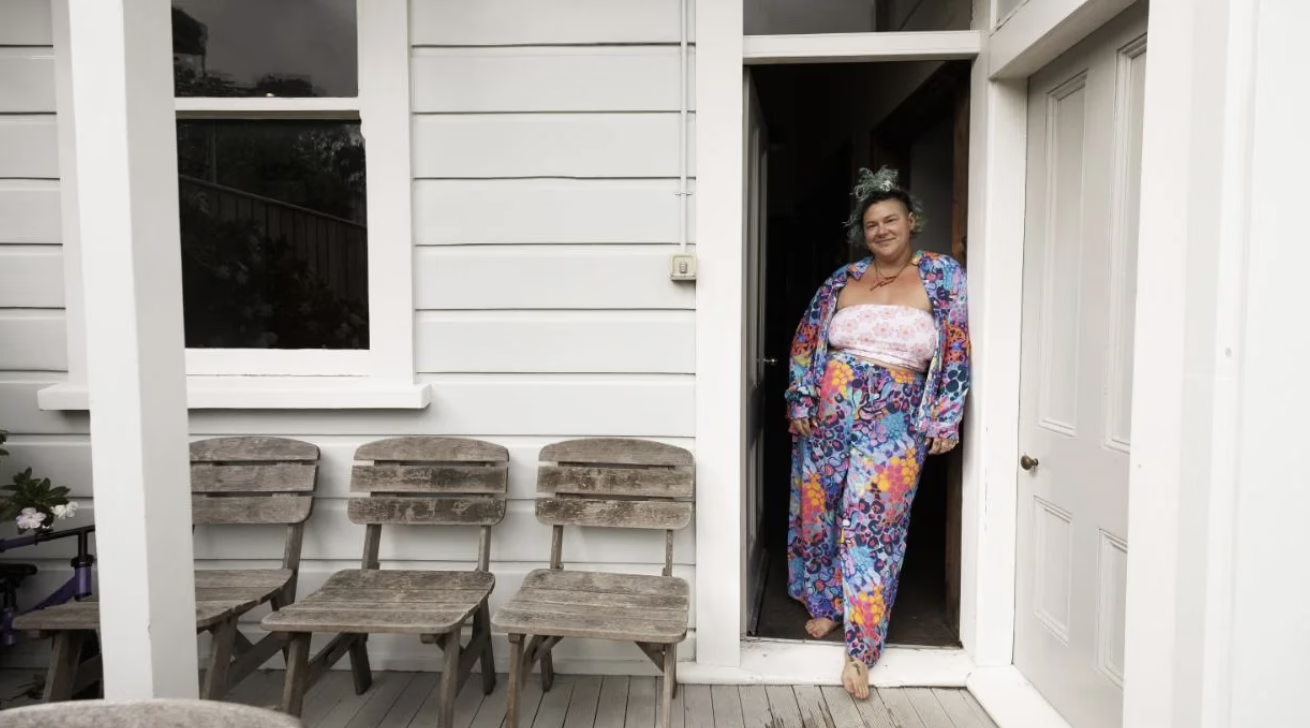
Sage Russo loves funky, eclectic and colourful Wellington.
Russo and Russo’s partner moved here from San Francisco a year ago after a debate about whether they would move to Auckland or Wellington.
The second Trump presidency had spurred them on their way, and it seemed like the universe pointed them toward the capital.
Russo had been in New Zealand before, learning surf lifesaving in Piha.
“I could not be more grateful for ending up here.”
For them, Wellington had everything they needed and wanted; an artistic community, connectedness, a respite from violence they lived with in the US.
“I cried at the kindy when we went to visit. Some of the kids were wearing those light-up shoes. They can’t do that in America because of potential active shooter situations,” Russo says.
They really wanted somewhere queer and immigrant friendly and Wellington – and their new Berhampore home – was it.
They are part of a slow trickle of people choosing Wellington, some from overseas but also returning from around the country.
Adam Ballett returned to Wellington, after a three-year working holiday, just two weeks ago and loves the compactness of the city.
His uncle had moved to the capital over 40 years ago and Ballett, who had visited him, says he has always had Wellington in mind as a first choice for a home.
Grant Foggo, founder and chief executive of Wellington residential property business Comprendé, says his team is starting to see people arrive in the capital from other parts of New Zealand and offshore.
Tenant enquiries are also gradually increasing, while some of the properties managed by the business are beginning to lease more quickly, he says.
He says that more than six months ago they had about 90 properties on their list; now they have about 30, which is much more normal
The changes are not dramatic, he says, but it suggests activity could be starting to pick up after a prolonged downturn.
He was hearing from the under-30s – professionals, nurses, tradespeople – who had done some travelling, were looking to settle and were told Wellington was the place to do it.
The influx comes as Wellington grapples with falling property values, a sluggish housing market and uncertainty over employment, particularly following public-sector restructuring.
The region’s housing market remains subdued. Wellington’s regional median sale price was down 3.1% on a year earlier in August, while the median property took 60 days to sell.
The number of residential sales recorded across the region that month was also the lowest for an August on record, he said.
But Foggo, whose business spans property management, short-stay accommodation and real estate sales, says the current slowdown should not necessarily be taken as a guide to Wellington’s future.
Foggo says the activity his team is seeing on the ground is worth watching.
He says the property market is still operating cautiously, with buyers, sellers and property owners holding off decisions while they wait for greater certainty around jobs, interest rates and the economy.
However, he believes that could change as people begin making decisions they have delayed.
A buyer might decide to purchase a home, a business might commit to another lease, or a developer might revisit a project that had been put on hold.
“It isn’t a rush, but something has changed,” he says of the rental market.
The decline in regional median sale price and the time it’s taking to sell “aren’t recovery numbers.
“But slow isn’t the same as dormant. Our latest Wellington Property Insights research found Wellington City still recorded 196 residential sales in July – more than any of the other major Wellington districts we track.
“People were still buying and selling; they’re simply doing it much more cautiously. But perhaps we’re asking the wrong question. Rather than asking whether Wellington has recovered, I think we should be asking what Wellington might look like three or four years from now.”
Foggo says only a few years ago they were dealing with precisely the opposite problem.
In early 2021, Wellington tenants were competing aggressively for homes. The region became the first in New Zealand to record a median rent above $600 a week.
“Buyers were competing just as aggressively, and prices were rising at a pace which, in hindsight, was clearly unsustainable. We are now operating in very different economic conditions. Markets do that.
“What concerns me about some of the commentary around Wellington today is the assumption that today’s conditions will continue indefinitely. History suggests they rarely do.”
There are also questions about whether Wellington will have enough new housing to meet future demand.
Stats NZ figures show new dwelling consents across the Wellington region fell from 3836 in the year ended March 2022 to 1893 in the year ended March 2025 – a drop of about 51%.
While the decline in construction means buyers currently have more choice, Foggo says the reduced pipeline of new homes could become more significant if demand strengthens over the next few years.
He is not predicting an imminent surge in house prices or rents, and acknowledges the capital’s economic challenges have not disappeared.
Instead, he says, Wellington should be careful about assuming the conditions of the past three years will continue indefinitely.
The city has experienced periods of intense housing demand before, with buyers and tenants competing for limited stock as prices and rents climbed.
Today’s market looks very different, but the balance between housing supply and demand could shift again as economic conditions change.
For now, the signs Foggo describes are tentative. But he believes the capital’s longer-term prospects should not be judged solely on the current economic difficulties.
New Trade Me Property figures out this week showed Wellington’s urban housing stock had fallen 6%, but that was less than Auckland which saw a drop of nearly 8%.
First-home buyers in the region were dominating the market with 37% of transactions those getting onto the property ladder for the first time.
Foggo says while people have been leaving Wellington, there are also still jobs to fill both in government and the private sector.
Deborah Morris
Original article here.